 Spectro
Spectro Team · July 21, 2026 · 4 min read
Suno AI Covers Are Flooding Streaming. What DJs Can Actually Check Today
The Verge showed how Suno Studio copyright filters can be bypassed to seed AI covers. What that means for DJ crates, and what Spectro 1.6 can check offline on Mac: fake lossless plus optional AI Screen Beta.
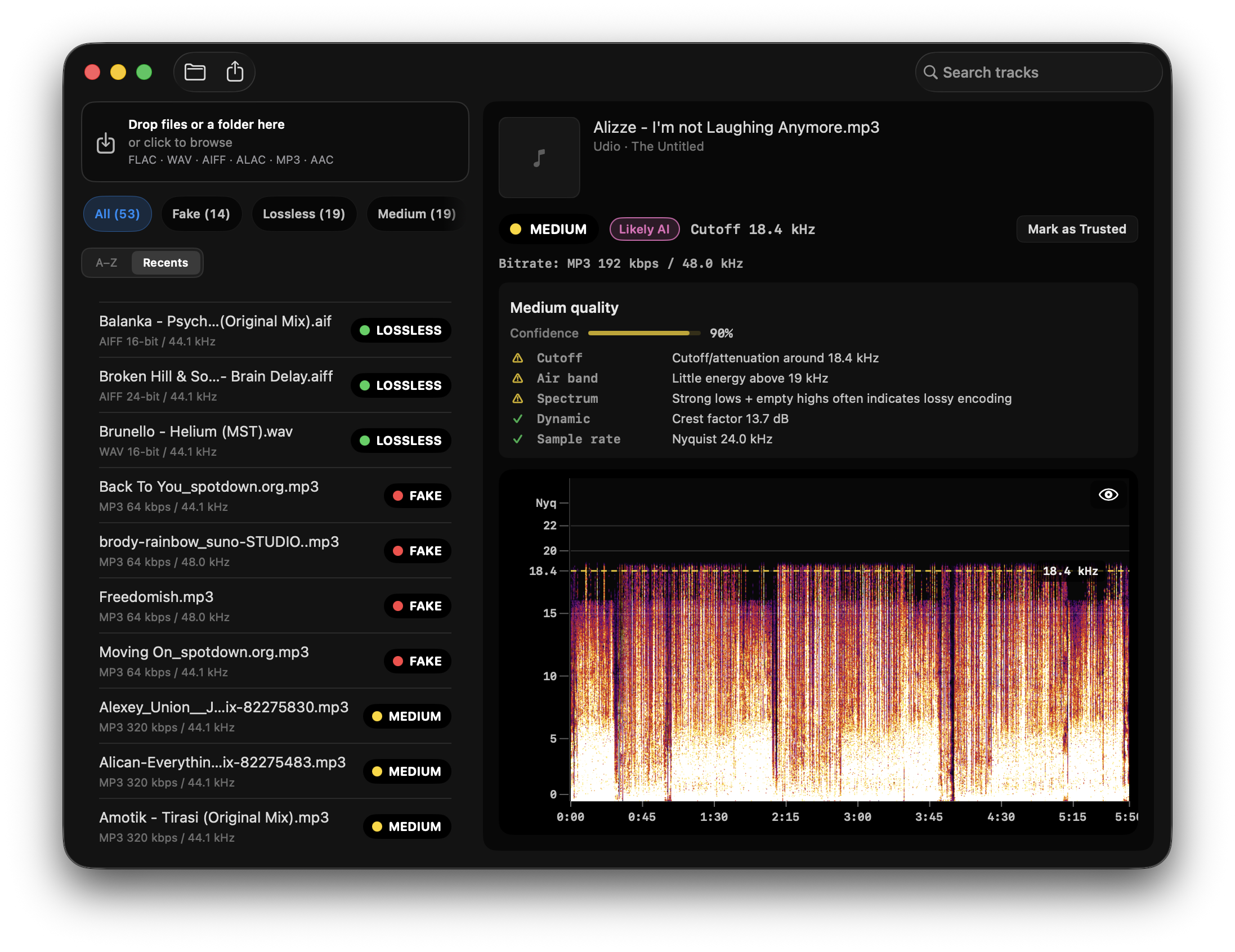
Quick Answer: The Verge reported that Suno Studio's copyright filters are easy to fool: slow or speed a hit in Audacity, add white noise at the edges, upload on the Premier plan, then restore timing and generate a cover that stays recognizably close to the original. Outputs can be exported and pushed through aggregators toward streaming. Indie catalogs are especially exposed. Spectro does not identify Suno and does not prove AI origin. Spectro 1.6 can flag some AI-platform tracks with optional AI Screen (Beta). On Mac you still batch-check downloads for fake lossless (LOSSLESS / FAKE / MEDIUM) first.
What did The Verge find?
Terrence O'Brien's report starts from Suno's own policy: no copyrighted material for remix or cover uploads. In practice, the Studio upload filter (Premier plan) often rejects a clean hit, but half-speed or double-speed versions frequently pass, and a burst of white noise at the start and end made bypasses more reliable. Timing and noise can then be fixed inside Studio so the copyrighted recording becomes the seed.
Without heavy style transfer, older models (4.5 / 4.5+) often kept the instrumental arrangement almost intact; v5 took more liberties but still left songs like “Freedom” or “Paranoid” unmistakable. Lyric filters blocked straight Genius pastes, yet tiny spelling tweaks were enough to get voice-like imitations through. The author also cleared the filter with unchanged uploads of smaller / self-distributed material (including his own track and other indie artists), while DistroKid and CD Baby declined to comment.
Two pipeline details matter for downstream listeners:
- Scan-on-upload only. The piece says Suno does not appear to recheck outputs or re-scan before export.
- Monetization path. Export → aggregator (e.g. DistroKid-style distribution) → streaming, without the royalties a licensed cover would normally pay composers.
Suno declined to comment. Spotify told The Verge it uses upload safeguards, similarity systems, and human review, while acknowledging the arms race. The story also covers artist-side damage: AI fakes landing on profiles (e.g. cases around Murphy Campbell, plus prior reports involving William Basinski and King Gizzard), sometimes followed by broken copyright claims against the real artist. Platform cleanup often happens only after public pressure.
Why should DJs care if they buy from Beatport?
Most club crates still come from stores, labels, and pools, not from ripping Spotify AI spam. Still:
- Promo pools and friend USBs mix sources.
- Some DJs pull reference rips or alternate versions from streaming.
- Chart and pool culture can surface tracks before platforms finish removals.
- “Uncanny valley” covers can sound like flat wedding-band clones of a hit: recognizable riff, lifeless dynamics. Ears catch some of that; metadata will not.
If a synthetic or heavily processed file lands in your staging folder, you still need library hygiene. Origin and quality are separate problems: a file can be genuine lossless and AI-generated, or human-made and fake lossless. See how AI music detection works for why classifiers are probabilistic, and AI on Beatport for store-side context.
What can you actually check today?
1. Fake lossless (supported now)
Drop the download folder into a native Mac offline checker. Spectro returns an automatic LOSSLESS, FAKE, or MEDIUM verdict per track from spectral analysis, with the spectrogram available for MEDIUM / edge cases. That catches MP3s and AACs wrapped as WAV/FLAC/AIFF. It does not say “made with Suno.”
2. AI-origin screening (Beta)
Spectro 1.6 optional AI Screen can flag some tracks from AI music platforms as Possible AI or Likely AI. Off by default. Enable in Settings. Subsequent scans only. Treat the flag as a signal, not proof. Expect false positives on vocoder-heavy and brick-wall mastered electronic music. Generators also change faster than frozen classifiers. Full workflow: how to detect AI-generated music files before import.
3. Ears and source trust
Uncanny covers often lack phrasing, dynamics, and rough edges even when the arrangement is obvious. Prefer labeled stores and known labels; quarantine anonymous drops and anything that appeared on an artist profile overnight.
What Spectro will not claim
We will not market Spectro as a Suno detector, a copyright oracle, or a substitute for Spotify/Deezer/Qobuz enforcement. AI Screen is Beta. It can flag some AI-platform songs for review. It can miss others. The honest product surface is still offline fake-lossless batch screening for Mac, plus an optional review flag if you enable it.
If you are cleaning a crate after a busy download week: stage the folder, run spectral verdicts first, then decide what deserves a listen or an AI Screen pass.
Related posts
Try Spectro free
100 tracks free. No account needed. Personal $24.99 for 1 Mac; Duo $39 for up to 2 Macs.
Download the free 100-track trial