 Spectro
Spectro Team · June 30, 2026 · 6 min read
AI-Generated Music on Beatport: What DJs Should Know in 2026
Beatport sells DJ music, but what happens when AI-generated tracks enter the charts? Policy, screening habits, and what DJs can verify before importing to Rekordbox or Serato.
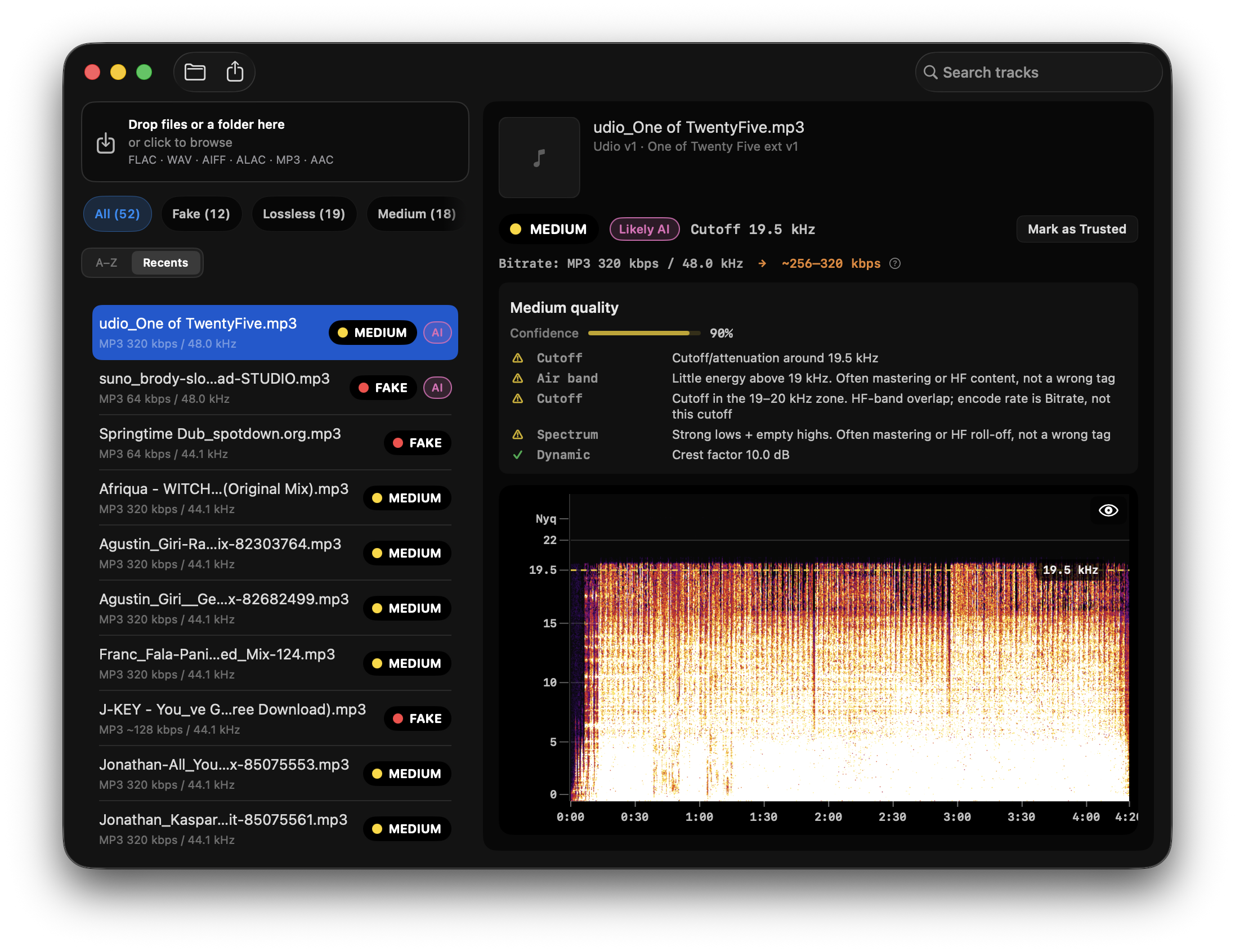
Quick Answer: Beatport's terms require sellers to accurately represent their content and prohibit misleading uploads. Industry reporting in 2025–2026 documented AI-generated tracks reaching dance charts and subsequent platform enforcement. DJs cannot assume every WAV download is human-made, the same distribution chain that occasionally delivers fake lossless files can also deliver undisclosed AI content. Screening before import is hygiene, not accusation. Spectro 1.6 can flag some AI-platform tracks with optional AI Screen (Beta). That flag is not proof of origin.
What does Beatport's policy say about AI-generated music?
Beatport's seller terms and content guidelines require accurate metadata and representation of uploaded material. Sellers must own or have rights to distribute what they upload. Content that misrepresents its origin, including AI-generated material presented as fully human-produced without disclosure where required, falls under standard misrepresentation and intellectual property rules.
Beatport has publicly stated that it reviews chart-eligible content and may remove tracks that violate its terms. Industry publications reported enforcement actions in 2025–2026 when AI-generated dance tracks reached chart positions without adequate disclosure, prompting discussion across DJ forums and producer communities.
This article does not name specific artists or tracks. The takeaway for DJs is procedural: platform policy exists, enforcement happens, and your library may still contain files uploaded before removal or from other sources.
Why do AI tracks on charts matter for working DJs?
Chart placement drives discovery. Promo pools, radio, and gig prep workflows often pull from trending releases. If an AI-generated track enters your crate through a chart-driven purchase or pool inclusion, you inherit questions that did not exist five years ago:
- Set identity, some venues and promoters care whether AI content is played.
- Rights clarity, AI training and output licensing remains legally unsettled in many jurisdictions.
- Audience trust, collectors and serious dancers notice when production feels synthetic, regardless of detection scores.
These are workflow and reputation concerns, not technical verdicts. A track can sound fine on a club system and still be something you would rather not have imported unknowingly.
How is AI on Beatport different from the fake lossless problem?
They overlap in the download-verify-import pipeline but differ in what you are checking:
| Concern | Question | What you might find |
|---|---|---|
| Fake lossless | Is this WAV actually a re-encoded MP3? | Hard frequency cutoff at 16–20 kHz |
| AI origin | Was this waveform synthesized by a generative model? | Statistical spectral artifacts, subtler, probabilistic |
A file can be genuine lossless and AI-generated, or fake lossless and human-made. Checking one does not check the other. DJs building a trustworthy library should plan for both dimensions.
Spectro screens fake lossless quality offline on Mac. Optional AI Screen (Beta) in 1.6 can add a review flag for some AI-platform tracks. Understanding how AI music detection works keeps that flag in the right box: screening, not proof.
What should DJs do before importing Beatport downloads?
A practical pre-import routine, extending the DJ library audit guide:
- Download to a staging folder, not directly into your main Rekordbox or Serato library.
- Run quality screening, spectral fake lossless check on the batch. Flag FAKE or unexpected MEDIUM results for replacement.
- Evaluate origin signals, listen for telltale synthesis artifacts. If AI Screen is on, review Possible AI / Likely AI flags. False positives happen on mastered electronic music.
- Import verified files, move clean files into your main library with accurate tags.
This adds minutes per purchase batch. It prevents discovering problems mid-tour or on a festival USB prep deadline.
Can you trust Beatport WAV files the same way you could in 2020?
For audio quality (lossless vs. transcoded), Beatport remains among the more reliable DJ stores, most major-label WAV deliveries are genuine. See our full analysis in Is Beatport actually lossless?.
For content origin (human vs. AI), the same distribution chain trust assumptions do not apply. A WAV can be bit-perfect lossless and still synthesized. Store reputation for audio encoding does not prove artistic provenance.
What has the industry reported about AI tracks on dance charts?
Music industry press documented cases in 2025–2026 where AI-generated tracks charted on Beatport and other platforms, triggering policy reviews and removals. The discourse centered on disclosure, label accountability, and chart integrity, not on spectral forensics.
DJs reading those reports should separate platform enforcement (reactive, after the fact) from personal library hygiene (proactive, before import). By the time a track is removed from a store, it may already be in your collection.
Do promo pools and DJ pools have the same AI risk?
Often higher. Promo pools aggregate material from labels, artists, and aggregators with varying upload standards. A pool track may never have been on Beatport at all. The how to detect AI-generated music files guide covers pre-import screening across sources, not just store purchases.
Should you remove AI tracks from your library if you find them?
That is a personal and professional choice, not a technical mandate. Some DJs delete AI content on principle. Others keep it for warm-up sets or do not care. Detection and screening give you information; policy gives you rules; taste gives you judgment.
If you play venues with AI content restrictions, knowing what is in your crate before you arrive is the minimum due diligence.
How does Spectro fit into this workflow today?
Spectro is a macOS app for offline batch spectral analysis of fake lossless audio. Drag a folder of Beatport downloads, get LOSSLESS, FAKE, or MEDIUM verdicts per file. Files never leave your Mac.
Optional AI Screen (Beta) in 1.6 can flag some songs from AI music platforms for review. Off by default. Enable in Settings. It does not change the Verdict, does not identify Suno, and does not prove a track was synthesized. The workflow value is still quality verification first, then an extra review flag if you want it.
What is the honest limit of any screening tool?
No tool, web upload or local batch, offers courtroom-grade proof of AI origin. Public research shows measurable artifacts (Deezer ISMIR 2025, arXiv:2506.19108), but vocoder-heavy human vocals, aggressive mastering, and lossy re-encoding create false positives. Screening reduces surprise; it does not end debate.
Beatport is still a primary source for DJ music. Most downloads are fine. The shift in 2026 is that fine now has two meanings, quality and origin. Fake lossless has a mature offline Verdict. AI Screen is a Beta review flag on top of that.
Related posts
Try Spectro free
100 tracks free. No account needed. Personal $24.99 for 1 Mac; Duo $39 for up to 2 Macs.
Download the free 100-track trial