 Spectro
Spectro Team · June 30, 2026 · 7 min read
How AI-Generated Music Detection Works (What Science Can and Cannot Prove)
How do researchers detect AI-generated music? A breakdown of spectral artifacts, vocoder fingerprints, and the limits of probabilistic screening, with honest caveats about false positives.
Quick Answer: AI-generated music detection works by measuring spectral and temporal artifacts left by generative pipelines, vocoder banding, unnatural phase coherence, and Fourier-domain patterns that differ from acoustic recordings. Peer-reviewed research (including Deezer's ISMIR 2025 work on Fourier artifacts, arXiv:2506.19108) shows these signals are measurable but not definitive. Detection is probabilistic screening, not proof of how a track was made. Heavy mastering, vocoder-heavy human vocals, and lossy re-encoding can trigger false positives.
Why do generative music pipelines leave measurable artifacts?
Text-to-music and diffusion-based generators do not record acoustic events. They synthesize waveforms through neural networks, often with vocoders, autoregressive decoders, or latent diffusion models that reconstruct audio from compressed representations.
Each stage introduces constraints:
- Vocoder reconstruction produces band-limited spectral patterns that differ from microphone-captured sound.
- Latent compression can leave periodic structures in the frequency domain when the model fills in missing detail.
- Training data biases mean generated audio tends toward statistically "average" spectral envelopes that forensic classifiers can learn to recognize.
Researchers at Deezer presented work at ISMIR 2025 demonstrating that Fourier-domain artifacts, measurable patterns in the frequency spectrum of generated tracks, can be used to distinguish AI-synthesized music from human recordings in controlled datasets. The paper (arXiv:2506.19108) is part of a growing body of public research on this problem. It does not claim perfect accuracy in the wild.
The core principle mirrors fake lossless detection: compression and synthesis leave fingerprints. The difference is that AI artifacts are subtler, evolve with each model generation, and overlap more with legitimately processed human music.
How do classifiers turn spectral data into a verdict?
Most published detection systems follow a similar pipeline:
- Decode the audio file to PCM (raw waveform samples).
- Extract features, mel spectrograms, MFCCs, Fourier magnitude spectra, or learned embeddings from a pretrained audio model.
- Classify with a machine learning model trained on labeled datasets of human vs. generated audio.
- Output a probability score or binary label, not a legal or provenance certificate.
Public datasets like SONICS and competition benchmarks (e.g., MediaEval AI Music Generation tasks) provide labeled training material. Performance on these benchmarks does not automatically transfer to your DJ promo folder, where files may be mastered, clipped, re-encoded, or spliced with human stems.
Detection tools you find online typically implement variations of this pipeline. They differ in model architecture, training data freshness, and whether analysis runs in a browser or locally on disk.
What are the main sources of false positives and false negatives?
False positives, human music flagged as AI, happen when:
- Vocoders and pitch correction (Auto-Tune, Melodyne exports) create spectral patterns similar to synthesis.
- Aggressive limiting and brick-wall mastering flatten dynamics in ways classifiers associate with generated audio.
- Low-bitrate lossy encoding removes detail that classifiers use to distinguish human recordings.
- Genre-specific production (hyperpop, vaporwave, heavily processed EDM vocals) sits in an ambiguous zone.
False negatives, AI music passing as human, happen when:
- The track was post-processed through analog emulation, tape saturation, or vinyl noise injection.
- A human artist blended AI-generated stems with real recordings.
- The generator model is newer than the detector's training data.
- The file was transcoded multiple times, washing out subtle artifacts.
This is why responsible detection framing uses words like screening, signal, and suspicious, not proof or confirmed AI.
How is AI detection different from fake lossless detection?
Fake lossless detection asks a narrower question: was this file lossy-encoded before it was wrapped in a WAV or FLAC container? The fingerprint, a hard frequency cutoff from MP3 or AAC encoding, is physical and permanent. Once the data above 16–20 kHz is discarded, it cannot be recovered.
AI origin detection asks a harder question: was this waveform produced by a generative model? The artifacts are statistical, model-dependent, and adversarially evolvable. A 128 kbps MP3 cutoff from 2009 is still detectable today; a Suno v4 artifact may not match a classifier trained on Suno v2.
For DJs, both questions matter for library hygiene, but they require different tools and different expectations. You can read how spectral fake lossless detection works in our deep dive on the science behind bitrate fingerprinting.
What can DJs do with this knowledge today?
You do not need to understand Fourier transforms to benefit from the screening mindset:
- Treat detection as a hygiene signal, not a verdict on artistic legitimacy.
- Scan new downloads before importing to Rekordbox, Serato, or Traktor, whether you are checking quality or origin.
- Keep a staging folder for purchases and promo pool downloads; run batch analysis before files enter your main library.
- Combine checks: a file can be genuine lossless and still be AI-generated, or fake lossless and human-made.
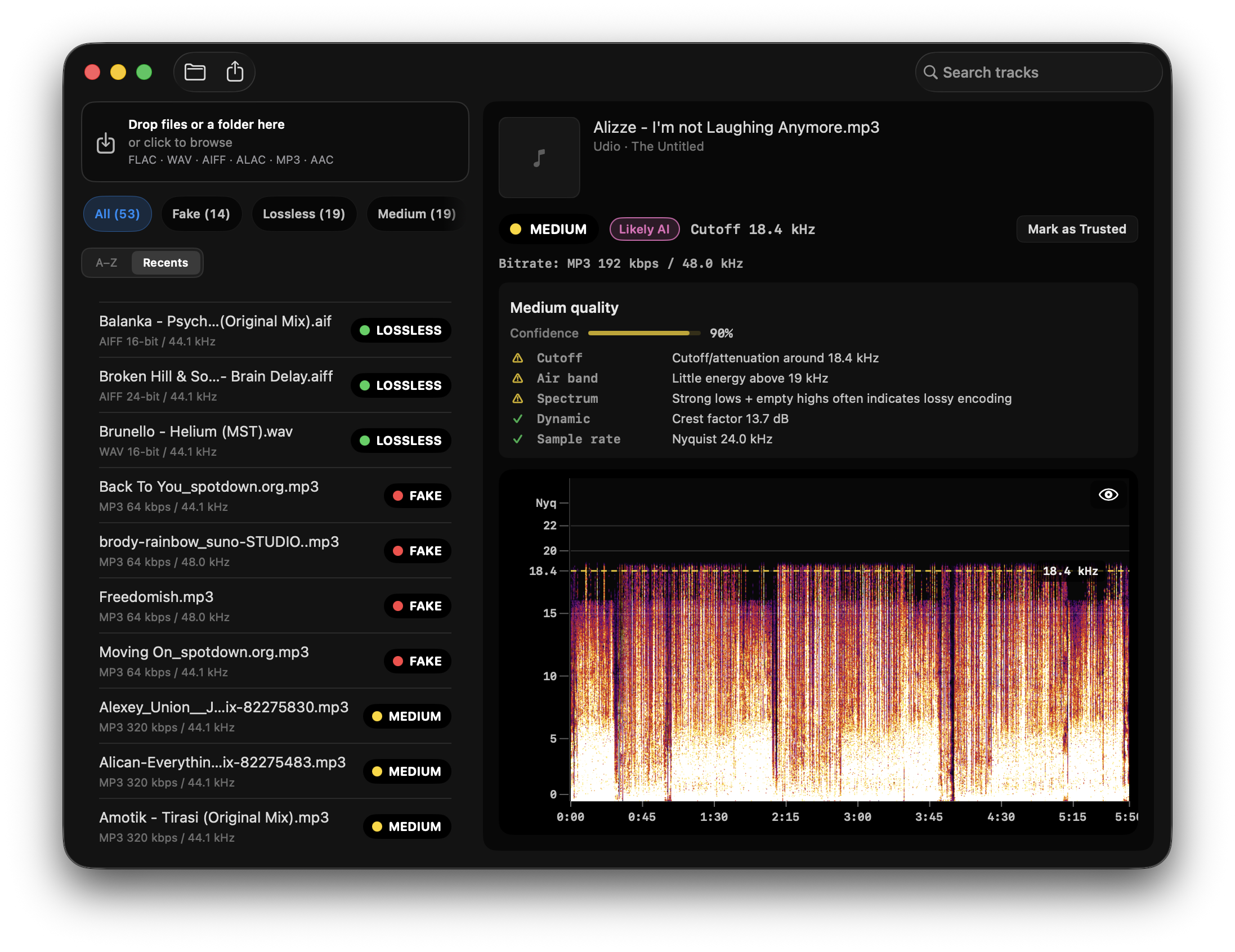
Spectro 1.6 still leads with fake lossless screening, offline batch spectral analysis on Mac. Optional AI Screen (Beta) can flag some tracks from AI music platforms for review. Off by default. Enable in Settings. It does not change the Verdict and does not prove origin.
For a practical import workflow, see how to detect AI-generated music files before you import a crate. For the full library audit process, see our DJ library audit guide.
Can AI music detection prove a track was made by a specific tool?
No. Public research demonstrates class-level discrimination, generated vs. human, not attribution to Suno, Udio, or any specific platform. Model families leave different artifact profiles, but attributing a file to a particular generator requires training data and labeled examples that most consumer tools do not publish.
Reporting in 2026 underlined how fast the pipeline moves: The Verge documented how Suno Studio's upload filters can be bypassed with Audacity-style speed changes and noise bursts, how tiny lyric edits defeat text blocks, and how indie / self-distributed tracks sometimes clear filters unchanged, then get exported toward aggregators and streaming. The report also notes scan-on-upload behavior without a clear recheck before export. Filters that fail at generation time, and platforms that clean up after the fact, make post-download screening more relevant for DJs, not less. That still does not mean a consumer tool can name “Suno v5” on a random WAV.
If a tool claims to name the exact generator, treat that as marketing unless it cites reproducible methodology and honest error rates on real-world audio.
Does mastering or Spotify-style loudness processing break detection?
It can. Brick-wall limiting, multiband compression, and codec transcoding alter the spectral envelope. Research detectors trained on clean generated audio often lose accuracy after heavy post-processing. This is one reason DJ libraries, where files come from Beatport, promo pools, SoundCloud rips, and friend's exports, are harder than benchmark datasets.
The honest response to a borderline score is inconclusive, not forced binary labeling.
Are web upload detectors accurate enough for a DJ library?
They can be useful for spot-checking a single file, but browser-based tools face memory limits, upload privacy concerns, and no batch folder workflow. For hundreds of tracks before a gig, offline local scanning is more practical: lossless quality as a Verdict, plus optional AI Screen Beta on the same crate.
See our comparison of online vs. offline lossless checkers for the parallel workflow argument.
Will detection keep working as AI models improve?
Probably not indefinitely without updates. Generative models improve faster than static classifiers. Research datasets and competition benchmarks refresh periodically, but any detector frozen at a point in time will degrade as new architectures emerge. This is an arms race, similar to deepfake detection in video, not a solved problem.
DJs should treat AI screening like antivirus signatures: useful when current, not a permanent guarantee.
Should DJs worry about AI tracks on platforms like Beatport?
Platform policy and chart discourse are evolving separately from the science. Beatport's terms require accurate representation of content; undisclosed AI-generated material has been subject to removal in public enforcement cases reported by industry press. For what that means in practice, without naming artists, see AI-generated music on Beatport: what DJs should know.
Related posts
Try Spectro free
100 tracks free. No account needed. Personal $24.99 for 1 Mac; Duo $39 for up to 2 Macs.
Download the free 100-track trial