 Spectro
Spectro Team · June 4, 2026 · 6 min read
Is Your Hi-Res Download Actually Hi-Res? Verify Qobuz, HDtracks, and Bandcamp
Qobuz, HDtracks, and Bandcamp sell 24-bit hi-res FLACs, but are they always genuine? Here's how to verify any hi-res download is actually hi-res, not an upsampled CD.
Quick Answer: Yes, a 24-bit/96kHz file from any store can still contain CD audio upsampled to hi-res. Sample rate and bit depth describe the container, not the source. Genuine hi-res audio has frequency content above 22 kHz. An upsampled file cuts off there regardless of what the filename or store page claims. You can verify any download in seconds with a spectral analyzer.
What makes a hi-res download genuinely hi-res?
A genuinely hi-res audio file has two characteristics: a high-resolution container (typically 24-bit/88.2 kHz, 24-bit/96 kHz, or higher) and source audio that was recorded or mastered at that resolution. Both matter. The container determines what the file can hold; the source determines what it actually holds.
The industry standard for hi-res is 24-bit/96 kHz or higher, as defined by organizations like the Japan Audio Society and adopted by streaming platforms. What the standard doesn't guarantee: that the music inside was ever captured at that resolution. A 24/96 FLAC containing a CD master is still just a CD, dressed in a larger box.
Can a Qobuz 24-bit download still be an upsampled CD?
Yes, though Qobuz has one of the stronger reputations for hi-res quality among dedicated audiophile stores. Qobuz works directly with labels and distributors for its hi-res catalog and has stated publicly that it does not upsample content. However, the quality of any given file ultimately depends on what the label delivered, and label delivery quality varies.
The most common scenario isn't intentional fraud: it's a recording that existed at 44.1 kHz before it was reissued as hi-res, a back-catalog title where the original master predates the hi-res era, or a remaster that was digitized at CD resolution and re-released with a 96 kHz spec. Qobuz can only deliver what it receives. Community spectrograms of WEB FLAC 24/96 that still die at 22 kHz are usually that catalog pattern, not an MP3 fake. Treat them as CD audio in a larger box. See How to Detect Fake Hi-Res Audio for the gap at 22–22.5 kHz on 48 kHz files.
Tidal MAX / Hi-Res FLAC has the same split: the container can be 24/96 while the master is CD. Is Tidal FLAC Really Lossless? covers the stream vs the file. Spectro cannot inspect DRM streams. Download a copy you own, then scan it.
If you're buying a reissue of a 1970s recording labeled as 24-bit/96 kHz, verifying the file is not paranoia, it's due diligence.
How does HDtracks handle hi-res quality?
HDtracks was one of the first dedicated hi-res download stores and has built its catalog around direct label relationships. Its reputation is generally solid, but the platform received attention in audiophile communities in earlier years for some catalog titles that turned out to be upsampled from CD sources.
The store has since improved its quality review processes, and the most recent reports from audiophile forums suggest the catalog is more reliable than it was. That said, the same principle applies as with any store: older catalog titles and budget reissues deserve a spot-check more than recent studio recordings.
Are Bandcamp hi-res downloads reliable?
Bandcamp occupies a different position: artists upload and control their own masters. This makes quality a direct function of what the artist, or their distributor, uploaded. An artist who recorded in 24/96 and exports their master directly will deliver genuine hi-res. An artist who recorded in 44.1 kHz and selected "24-bit/96kHz" on their Bandcamp upload settings will deliver an upsampled file.
There is no systematic quality review at the file level for most Bandcamp releases. For independent artists this is especially unpredictable, the variability is high. For major labels distributing through Bandcamp, the same distribution-chain caveats apply as with any store.
Bandcamp's strength is direct artist-to-listener economics and often unrestricted format choice. Its weakness, from a quality-verification standpoint, is the absence of a systematic review process.
What does fake hi-res look like compared to genuine hi-res?
The difference is visible in the frequency spectrum. Open a genuine 96 kHz recording in any spectral analyzer and you'll see audio energy extending toward the 48 kHz Nyquist, not necessarily loud, but present: overtones, room ambience, the natural rolloff of real instruments in real spaces.
An upsampled file from a 44.1 kHz source has a hard cutoff at approximately 22 kHz, the original Nyquist. The spectrum above that is either flat noise or empty. The file is larger (96 kHz files are roughly 2.2× the size of 44.1 kHz), but the audio data doesn't justify the size.
A variant pattern: files upsampled from 44.1 to 48 kHz show a characteristic dead zone at 22–22.5 kHz, where the original audio ends before reaching the 48 kHz ceiling. This gap is the clearest visual signature of 44.1→48 kHz upsampling and is what Spectro’s Verdict Engine v1.5 targets. See How to Detect Fake Hi-Res Audio for a detailed breakdown of what each pattern looks like.
How do you verify a hi-res download from any store?
The method is the same regardless of store:
- Download the file to your Mac.
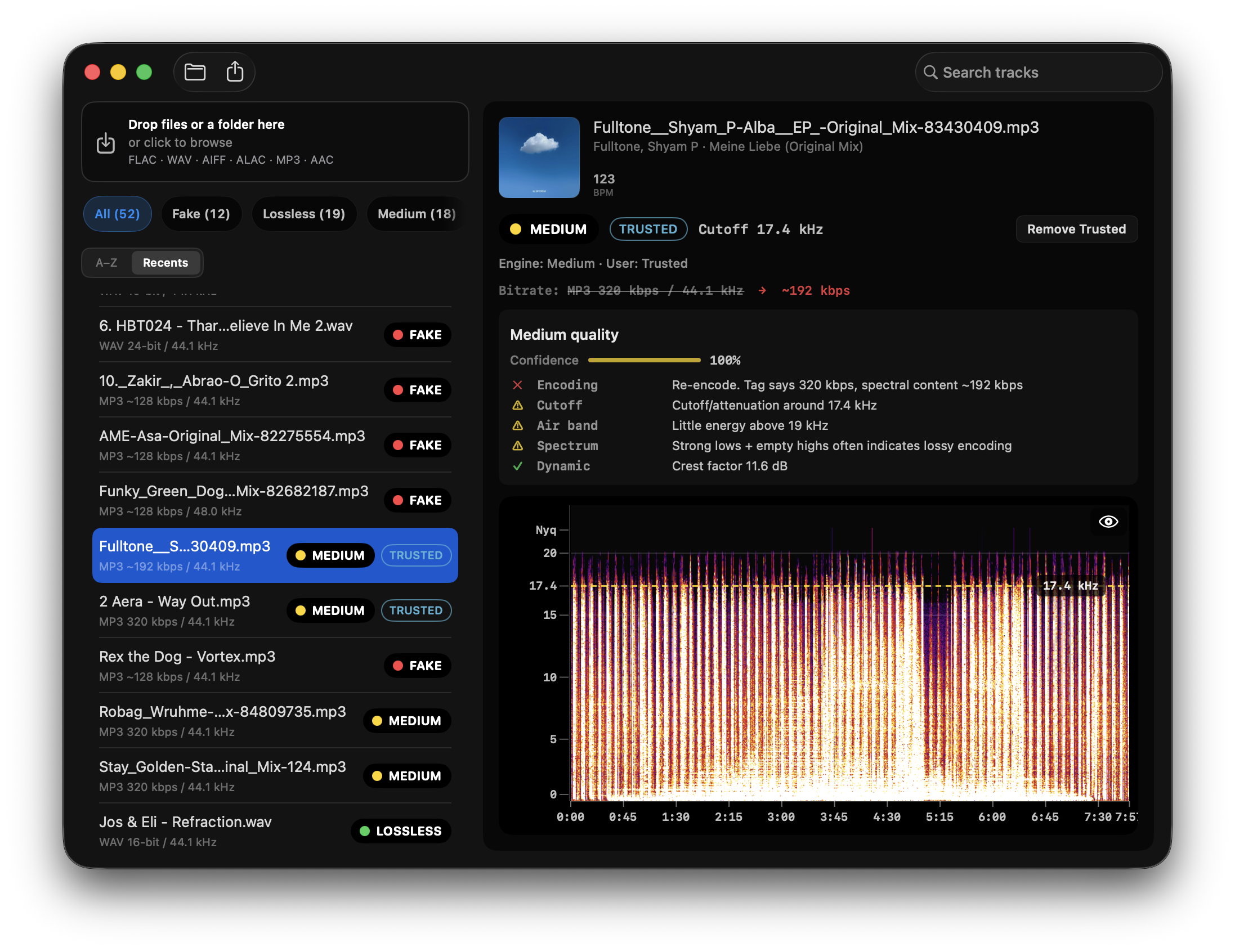
- Drop it into Spectro's fake FLAC detector for Mac.
- Check the estimated cutoff in the diagnosis panel.
If the file is a genuine 96 kHz recording, the cutoff will be well above 22 kHz, typically 30 kHz or higher for recordings with significant upper-register content. If the cutoff reads 21–22 kHz, the audio source is CD quality at best, regardless of the declared sample rate.
For detailed visual confirmation, click the file to open the spectrogram. Genuine hi-res looks like audio that extends and gradually rolls off toward the Nyquist ceiling. Upsampled audio ends abruptly at a specific frequency and stays flat or empty above it. The difference is unmistakable once you know what to look for, and Spectro's guide to genuine vs. fake lossless walks through the visual patterns in detail.
Which stores have the best hi-res reliability in practice?
No store can be rated with certainty because the quality of any individual title depends on the source master, not the platform. What does vary is the depth of quality review processes and the directness of label relationships.
Stores that specialize in hi-res audio and work directly with labels for digital delivery tend to have fewer upsampled titles in their current catalog. Consumer-facing platforms that aggregate from multiple distributors, or that allow direct artist upload without systematic file-level review, have more variance.
The practical answer: verify the files you care about. For a $2.49 track you'll play once, the check takes ten seconds. For a $25 hi-res album you're archiving in a curated library, it's worth the extra step.
Related posts
Try Spectro free
100 tracks free. No account needed. Personal $24.99 for 1 Mac; Duo $39 for up to 2 Macs.
Download the free 100-track trial